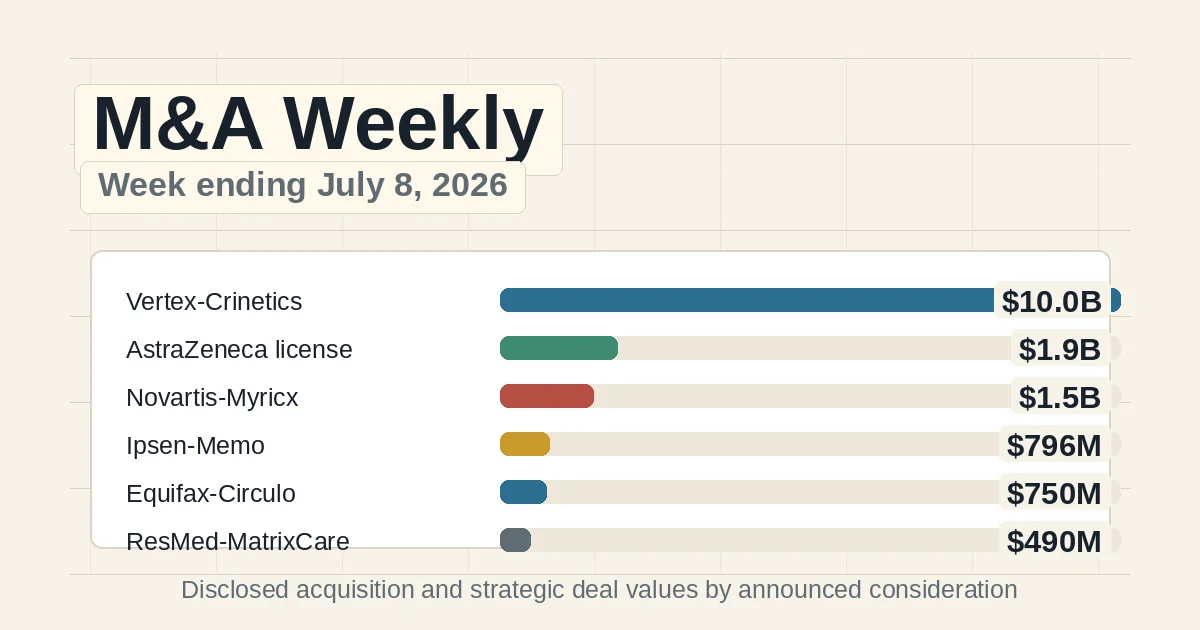
Industry M&A Weekly: Vertex's $10B Crinetics Deal, AstraZeneca's $1.9B License, and Four More
A week-ending July 8 briefing on six disclosed deals across biotech, fintech data, and healthcare software, led by Vertex's $10B Crinetics acquisition and AstraZeneca's $1.9B ex-China COPD license. The issue separates full acquisitions from strategic licenses and shows how buyers are adding specialized profit pools.

Vertex put the week's biggest number on the board with a $10.0 billion cash agreement for Crinetics, but the more useful signal is not just size. Buyers are paying for assets that move them into controlled, specialized profit pools: rare endocrine drugs, ADC payloads, respiratory rights, post-acute software, and Mexican credit data.
Deal snapshot
| Deal | Sector | Consideration | Strategic read |
|---|---|---|---|
| Vertex to acquire Crinetics | Biotech | About $10.0B equity value, or about $8.8B net of estimated cash acquired 1 | Vertex adds a marketed rare-endocrine drug and a Phase 3 CAH candidate with a stated combined peak-sales opportunity above $5B. 1 |
| AstraZeneca licenses Sino Biopharmaceutical's COPD drug outside China | Biotech strategic license | $200M upfront; milestones could take total payments to $1.9B 2 | AstraZeneca deepens its COPD pipeline around a Phase 2 asset while leaving China rights with Chia Tai Tianqing. 2 |
| Novartis to acquire Myricx Bio | Biotech | $1.1B upfront plus up to $400M in milestones 3 | Novartis is buying an NMTi antibody-drug conjugate payload platform and two lead ADC assets, aimed at solid tumors and resistance to current payload classes. 3 |
| Ipsen to acquire Memo Therapeutics | Biotech | EUR200M at closing, with total potential consideration above EUR700M 4 | Ipsen adds potravitug, a Phase 2 BK polyomavirus antibody for kidney transplant patients with no targeted approved treatment. 4 |
| Equifax to acquire Circulo de Credito | Fintech/data | $750M enterprise value; $825M purchase price net of estimated $75M cash at closing 5 | Equifax enters Mexico's credit bureau market and gets an alternative-data platform serving banks, fintechs, lenders, retailers, and telecoms. 5 |
| ResMed to sell MatrixCare to Frazier Healthcare Partners | Healthcare software | $490M cash 6 | ResMed exits a post-acute software asset to focus capital on sleep, breathing, and connected home-based care. 7 |
What changed hands
Vertex buys a commercial rare-endocrine platform
Vertex agreed to pay $85 per Crinetics share in cash, for a total equity value of about $10.0 billion. The company said the transaction brings PALSONIFY, a once-daily oral therapy for adults with acromegaly, plus atumelnant, a Phase 3 ACTH receptor antagonist for congenital adrenal hyperplasia. Vertex put the combined annual peak-sales opportunity for those assets at more than $5 billion. 1
The fit is easy to see. Vertex already sells in serious specialty diseases, but it remains heavily associated with cystic fibrosis. Crinetics gives it an endocrine vertical with one launched product, one late-stage program, and a pipeline of GPCR-targeted small molecules. The transaction is expected to close in the third quarter of 2026 and become accretive to non-GAAP operating income in 2029. 1
Novartis pays for the next ADC payload race
Novartis' Myricx deal is smaller than Vertex-Crinetics, but it sits in one of oncology's hottest platform markets. Myricx is developing antibody-drug conjugates using N-myristoyltransferase inhibitor payloads, including lead assets directed at B7-H3 and HER2. Novartis said the platform may address limitations of common ADC payload classes such as TOPO-1 inhibitors. 3
The consideration is clean: $1.1 billion upfront and up to $400 million in milestones. That is a large check for a private, preclinical oncology company, but the buyer is not just taking two programs. It is buying a payload mechanism that could be applied across more targets if the clinical data hold up. 3
AstraZeneca takes ex-China COPD rights
The AstraZeneca deal is not a full acquisition, but the disclosed economics make it material enough for this week's deal screen. Sino Biopharmaceutical said AstraZeneca will pay $200 million upfront for rights outside China to TQC3721, an experimental COPD drug from Chia Tai Tianqing. Development, regulatory, and sales milestones could lift total payments to $1.9 billion. 2
AstraZeneca already has scale in respiratory disease, so this is a pipeline-extension transaction rather than a market-entry move. The open question is how TQC3721 will sit alongside AstraZeneca's own COPD programs if future global studies support the China Phase 2 signal reported by Sino Biopharmaceutical. 2
Ipsen adds a transplant-infection asset
Ipsen's Memo acquisition targets one asset: potravitug, a Phase 2 monoclonal antibody against BK polyomavirus in kidney transplant recipients. The company said Memo shareholders will receive EUR200 million at closing, with deferred development, regulatory, and sales milestones taking total potential consideration above EUR700 million. 4
The medical need is specific. Ipsen says there are no approved targeted therapies for BKPyV, while high BK viral loads affect about 30% of kidney transplant patients within the first year after transplant. Memo's other assets and employees not related to potravitug are to be moved into a new company, Memorises Bio, before closing. 4
Equifax buys Mexican credit infrastructure
Equifax's $750 million enterprise-value agreement for Circulo de Credito is the week's clearest fintech data deal. The Mexican credit bureau produced estimated revenue of $134 million and adjusted EBITDA of $62 million for the 12 months ended June 30, 2026. Equifax also said Circulo has more than 1,700 bank, retail, fintech, small-business lending, microfinance, and telecom customers. 5
The rationale is geographic and data-driven. Circulo brings 2 billion tradelines across 80 million validated identities, with alternative data including gig-economy, utility, and telecom payment history. Equifax framed the deal as an entry into Mexico, the second-largest economy in Latin America, and a way to expand financial inclusion through more underwriting data. 5
ResMed trims software to focus the portfolio
ResMed agreed to sell MatrixCare, its post-acute software business, to Frazier Healthcare Partners for $490 million in cash. MatrixCare serves more than 15,000 providers across skilled nursing, senior living, long-term care, home health, and hospice markets. The deal excludes ResMed's other software businesses, Brightree in the U.S. and MEDIFOX DAN in Germany. 6
The divestiture has a straightforward capital-allocation story. MatrixCare generated about $220 million of revenue and $55 million of non-GAAP operating profit in fiscal 2026. ResMed said it plans to use net proceeds for capital returns, including an accelerated share repurchase program, and general corporate purposes. 7
Themes to watch
Biotech buyers are paying for portfolio shape, not just single programs. Vertex gets a commercial endocrine product plus late-stage pipeline depth. Novartis gets a payload platform. Ipsen gets one clinical-stage transplant-infection asset but leaves Memo's non-potravitug assets behind. The shared pattern is narrower than "biotech M&A is back": buyers are using deal structure to add a very specific therapeutic surface area.
Licensing remains a substitute for owning the company. AstraZeneca's TQC3721 agreement has acquisition-scale economics without an acquisition. That matters for China-originated pharma assets because global buyers can secure ex-China rights while the originating company keeps its domestic market and part of the economics.
Software assets are being split by strategic owner type. Equifax is adding data infrastructure because it plugs directly into its credit-decisioning network. ResMed is selling MatrixCare because the post-acute software business no longer appears central to its sleep and connected-care strategy. Both deals are software or data-heavy, but the buyer logic runs in opposite directions.
References
- 1Vertex to Acquire Crinetics Pharmaceuticals
- 2AstraZeneca secures ex-China license for Sino Biopharmaceutical's experimental COPD drug
- 3Novartis agrees to acquire Myricx Bio, advancing next-generation antibody-drug conjugate innovation
- 4Ipsen to acquire Memo Therapeutics AG
- 5Equifax Announces Definitive Agreement to Acquire Circulo de Credito in Mexico
- 6ResMed to sell software business MatrixCare for $490 million
- 7ResMed to sell MatrixCare for $490M in cash
Related content
- Sign in to comment.
More from this channel
- Industry M&A Weekly: Merck's $11.3B Bio-Techne Deal, Qualcomm's Modular Bet, and Four More
- Industry M&A Weekly: AbbVie’s $10.9B Apogee Bet and Four More Deals
- Industry M&A Weekly: SpaceX's $60B Cursor Bet, Nuvei Buys Payoneer, and Four More Deals
- Industry M&A Weekly: GSK's $10.6B Nuvalent Deal, Incyte's Bleeding-Disorder Bet, and Three More